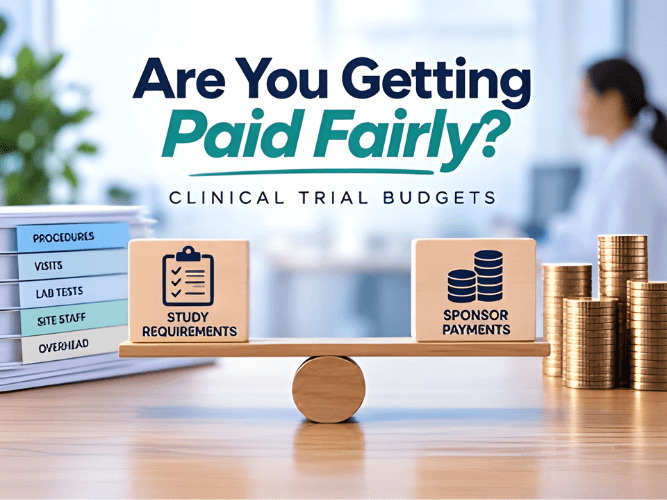
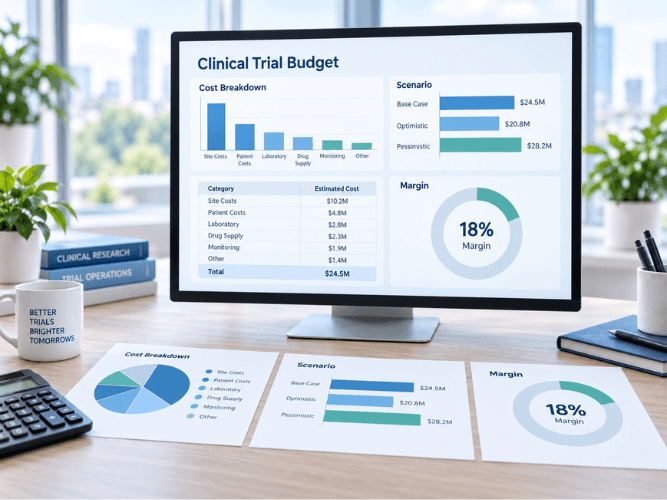
Winning a clinical trial is exciting. But an awarded study does not automatically mean a profitable study.
One of the most common financial challenges research sites face is accepting sponsor-provided budgets without fully evaluating the actual cost of conducting the protocol. A study may appear financially attractive on paper while quietly creating losses through underpriced procedures, uncompensated staff time, missed invoiceable items, or unrealistic enrollment assumptions.
A strong clinical trial budget should do more than cover direct patient visits. It should account for the true operational cost of conducting the study.
Start With the Protocol, Not the Sponsor Budget
The sponsor's proposed budget is a starting point - not necessarily an accurate reflection of what the study will cost your site.
Before negotiating, review the protocol carefully and identify every activity your team will be expected to perform.
Consider the time required from investigators, coordinators, nurses, pharmacists, regulatory personnel, data-entry staff, and administrative teams. Evaluate procedures, supplies, equipment requirements, monitoring visits, training, pharmacy activities, specimen handling, document storage, and close-out responsibilities.
A procedure that appears simple may require coordination across several employees. That operational burden needs to be reflected in the budget.
Calculate Your True Cost
Knowing your internal costs gives your site a defensible basis for negotiation. Each procedure should account for more than the employee's hourly wage. Sites should consider compensation, benefits, administrative time, facility costs, technology, supplies, management oversight, and other indirect expenses associated with delivering the service. Without understanding these costs, sites may negotiate based on what a sponsor offers rather than what the activity actually costs to perform.
Don't Overlook Invoiceable Items
Not every research-related activity occurs during a scheduled patient visit. Many studies include separately invoiceable items such as:
Screen failures, unscheduled visits, safety reporting, pharmacy start-up, monitoring visits, close-out activities, storage, protocol amendments, re-consenting, study training, record retrieval, and administrative fees.
If these activities are performed but never invoiced, the site has completed work without receiving the revenue it negotiated.
That is one of the most preventable forms of revenue leakage in clinical research.
**Evaluate Enrollment Assumptions ** A study budget may look profitable based on projected enrollment but perform very differently if recruitment is slower than expected. Before accepting a study, model several scenarios.
What happens if you enroll ten patients? Five? Two? What happens if screen-failure rates are higher than anticipated? What happens if the study remains open for twice as long as expected?
Looking at the financial impact before accepting the study helps leadership understand both the opportunity and the risk.
Negotiate With Data
Budget negotiation should not simply consist of requesting a percentage increase. The strongest negotiations are supported by operational data.
If a procedure requires 90 minutes of coordinator time, physician review, laboratory handling, and documentation, the site should be able to explain those components.
Data-driven negotiations make it easier to demonstrate why the sponsor's proposed amount does not adequately cover the work required.
**Profitability Starts Before the First Patient ** The financial success of a clinical trial is often determined before the study ever opens.
A carefully constructed budget allows your site to understand its costs, negotiate from a stronger position, capture all billable activities, and make informed decisions about which studies are financially sustainable.
The goal is not simply to secure more studies. The goal is to secure studies that make financial sense for your organization.
**Elevate Research Finance helps research sites evaluate financial feasibility, build defensible study budgets, and negotiate sponsor terms with site sustainability in mind.
Ready to understand whether your next study is financially viable? Schedule a free discovery consultation with Elevate Research Finance.**